Some Thoughts on the Common Forest
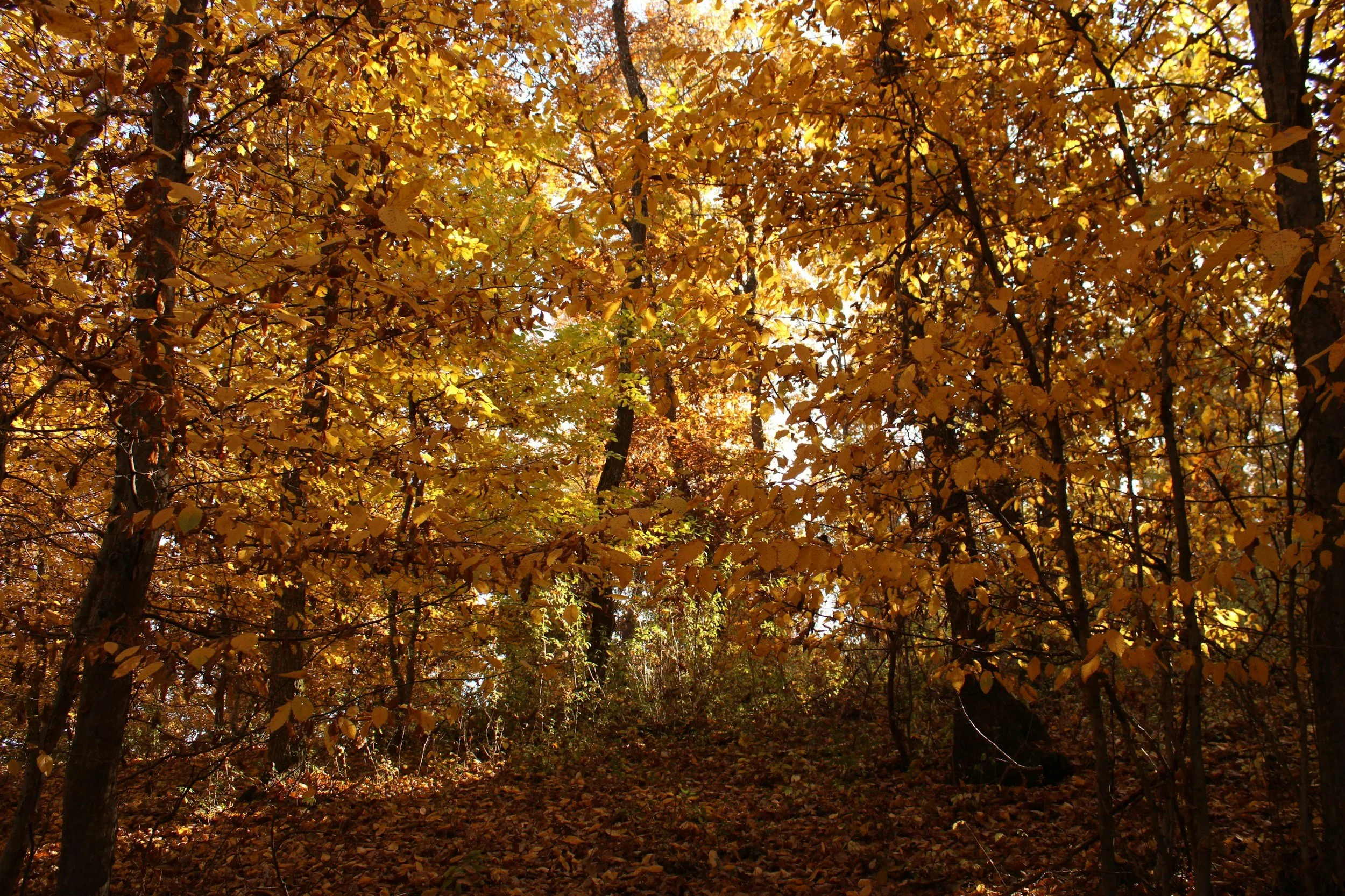
We live in a world that rewards distraction. The more quickly we move, the more tasks we complete, the more information we absorb, the more we are told we are keeping up. But at what cost? “We have given our hearts away, a sordid boon.”¹ We race past the world’s quiet wonders, blind to the intricate patterns of a leaf, the patient resilience of a river smoothing stone, the solemn presence of a heron standing at the water’s edge. We forget, in all our doing, how to simply be.
But there are voices—writers, poets, thinkers—who remind us of what we have forgotten. They tell us that in troubled times, in moments of uncertainty and hardship, the answer is not to move faster or try harder. The answer, instead, is to pause. To look. To listen. “I come into the peace of wild things who do not tax their lives with forethought of grief.”² There is something steadying about this: the knowledge that the world continues, regardless of our worries. “The smallest sprout shows there is really no death, And if ever there was it led forward life, and does not wait at the end to arrest it, And ceas’d the moment life appear’d.”³ Even in our darkest moments, the world hums with life.
This is an attempt to listen to those voices. I want to explore what it means to be present in a world that rushes us past presence, to find beauty when all seems bleak, to insist upon wonder as an act of defiance. Let the words settle in you. Let them remind you of something you once knew.
The Simple Things That Save Us
“The world is charged with the grandeur of God,”⁴ but we do not see it. We step over the beetle burrowing into the earth, we fail to notice the tree whose roots have cracked the pavement, whose leaves cast shifting shadows across the sidewalk. But there is wisdom in looking closely. “The point is that the pleasures of spring are available to everybody, and cost nothing.”⁵ And in those pleasures, something shifts. The world expands. “To see clearly,” Ruskin wrote, “is poetry, prophecy, and religion—all in one.”⁶ There is something sacred in attention. “Around me the trees stir in their leaves and call out, ‘Stay awhile.’”⁷
How often do we resist this? We tell ourselves we have no time. That the work must be done. That there is too much to fix, too much to fight, too much to fear. But “though much is taken, much abides.”⁸ The work will always be there, but so too will the morning birds, the hush of a snowfall, the laughter of a child at play. “Bring your gifts and graces and tell your secrets to this lonely country child!”⁹
And yet, we build our walls. We separate ourselves from the wild, from the dirt, from the messiness of life. “Something there is that doesn’t love a wall.”¹⁰ But to return to the world, to let our hands brush against bark, to listen to the slow lapping of water against stone, is to remember something essential. “You only have to let the soft animal of your body love what it loves.”¹¹
Even in Darkness, Beauty Persists
These moments of quiet attention are not naïve. They are not an escape from the world’s troubles but a way of grounding ourselves within them. “The night is darkening round me,”¹² but even in the dark, stars remain. “I have seen the sun break through to illuminate a small field,”¹³ and that is enough.
It is easy to despair. It is easy to believe that nothing good remains, that the world is only fire and hunger and cruelty. But “there is pleasure in the pathless woods.”¹⁴ Even in war, even in exile, even in grief, there is the scent of rain on dry earth, the golden glow of a candle in the window. “A mile of warm sea-scented beach. Three fields to cross till a farm appears.”¹⁵
“To see a World in a Grain of Sand, And a Heaven in a Wild Flower—Hold Infinity in the palm of your hand, And Eternity in an hour.”¹⁶ This is not sentimentality. This is survival. To see beauty, to insist upon it, is an act of resistance against despair. “Stand still. The forest knows where you are. You must let it find you.”¹⁷
The Discipline of Seeing
It is not always easy to see. Some days, the world feels dim, flat, drained of color. We grow weary, numb to the things that once made us glad. And yet, “the trees are coming into leaf like something almost being said.”¹⁸ The world does not stop because we have forgotten how to look. The world does not stop because we have turned away. But, “if you will stay close to nature, to its simplicity, to the small things hardly noticeable, those things can unexpectedly become great and immeasurable.”¹⁹
We must practice looking. We must cultivate the discipline of seeing. “If you suddenly and unexpectedly feel joy, don’t hesitate.”²⁰ Stop. Look. Be astonished. “There is always one moment in childhood when the door opens and lets the future in.”²¹ The door opens again and again, if only we will step through it.
In the end, what is left to us but this? The sound of the wind in the trees. The slow movement of light across a wooden floor. The sensory experiences available to us in our present moment conceal untold possibilities, but only when we pay attention. “Then they start and tremble, they call us by our name, and as soon as we have recognized their voice the spell is broken. We have delivered them: they have overcome death and return to share our life.”²² To be alive is to witness, to be present, to see. “The world is full of magic things, patiently waiting for our senses to grow sharper.”²³
“And then, the glory, so that a cricket song sweetens his ears, the smell of the earth rises chanting to his nose, and dappling light under a tree blesses his eyes. Then a man pours outward, a torrent of him, and yet he is not diminished.”²⁴ Walk outside. Stand still. Let the forest find you.
Quotation Sources
William Wordsworth, The World Is Too Much with Us.
Wendell Berry, The Peace of Wild Things.
Walt Whitman, Song of Myself.
Gerard Manley Hopkins, God’s Grandeur.
George Orwell, Some Thoughts on the Common Toad.
John Ruskin, Modern Painters.
Annie Dillard, Pilgrim at Tinker Creek.
Alfred, Lord Tennyson, Ulysses.
Sarah Orne Jewett, A White Heron.
Robert Frost, Mending Wall.
Mary Oliver, Wild Geese.
Emily Brontë, The Night is Darkening Round Me.
R.S. Thomas, The Bright Field.
Lord Byron, Childe Harold’s Pilgrimage.
Robert Browning, Meeting at Night.
William Blake, Auguries of Innocence.
David Wagoner, Lost.
Philip Larkin, The Trees.
Rainer Maria Rilke, Letters to a Young Poet.
Mary Oliver, Don’t Hesitate.
Graham Greene, The Power and the Glory.
Marcel Proust, In Search of Lost Time.
W.B. Yeats, Mythologies.
John Steinbeck, East of Eden.