What We Burn For
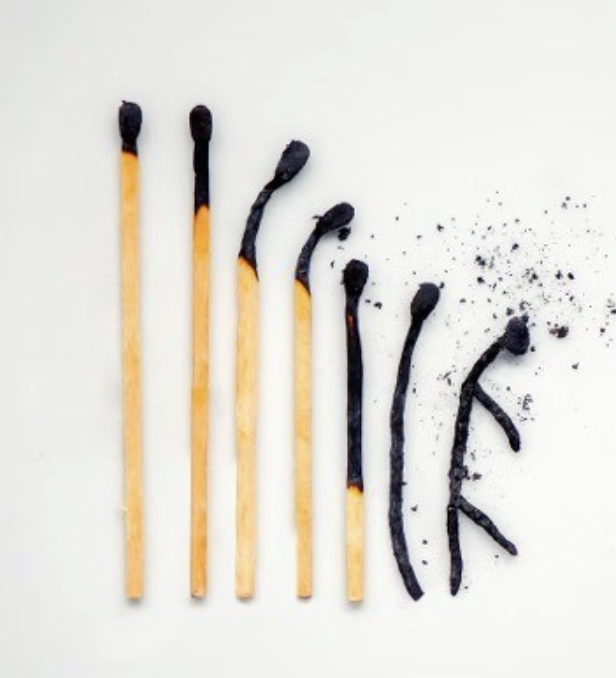
Burnout is everywhere. We read about it in headlines, we hear about it in staff lounges, and we feel its weight in our own bodies. Millennials are increasingly being labeled the “burnout generation,” and not without reason. Recent surveys show that more than 70 percent of young professionals report symptoms of burnout. Yet for all this attention, burnout remains a poorly understood concept, often reduced to a simplistic formula: work too much, and you will burn out.
This is false, or at least it is incomplete.
There are plenty of people working grueling schedules; surgeons, teachers, small business owners, and new parents, who remain deeply motivated. At the same time, there are individuals working part-time jobs who feel overwhelmed by fatigue, disillusionment, and disengagement. What accounts for this disparity?
My contention is this: burnout does not result merely from how much you are working. It results from a mismatch between the effort you are putting in and the meaning you are deriving from that effort. Burnout occurs when work becomes psychically disconnected from purpose. When labor no longer resonates with your values or contributes to something you believe in, exhaustion arises, not just physical exhaustion, but exhaustion of the will.
What Burnout Really Is
The World Health Organization defines burnout not simply as exhaustion but as a syndrome “resulting from chronic workplace stress that has not been successfully managed.” It is characterized by three dimensions: feelings of energy depletion, increased mental distance or cynicism related to one’s job, and reduced professional efficacy.¹ Notably, workload alone is not the defining cause; it is stress that is persistent and unalleviated by meaning or support.
Christina Maslach, whose Maslach Burnout Inventory remains the standard diagnostic tool, identifies six key mismatches that contribute to burnout: workload, control, reward, community, fairness, and values.² Of these, values is often the most neglected. Maslach argues that when there is a disconnect between personal values and organizational culture, the psychological cost becomes untenable. People begin to feel that their daily work is severed from what they care about most. That is where burnout begins.
Viktor Frankl and the Power of Meaning
Viktor Frankl, a Holocaust survivor and psychiatrist, understood this concept intuitively. In his seminal book Man’s Search for Meaning, Frankl wrote, “Those who have a ‘why’ to live can bear with almost any ‘how.’”³ His time in Nazi concentration camps convinced him that people can endure enormous suffering if that suffering serves a meaningful purpose. From this insight, he developed logotherapy, a school of psychotherapy premised on the idea that the human will to meaning is more fundamental than the pursuit of pleasure or power.
Logotherapy provides a powerful framework for understanding burnout. When we lose connection to the meaning of our work, our psychological resilience crumbles. The tasks may not become harder in a technical sense, but they become heavier, because they are no longer anchored by a compelling reason to persevere. Burnout, then, is not merely depletion; it is disorientation. It is what happens when the “why” disappears.
Empirical Support
This hypothesis is increasingly confirmed by research. A 2019 study published in BMJ Open found that lack of meaningful work was the most significant predictor of physician burnout, even more than the number of hours worked.⁴ A 2021 Gallup study likewise found that employees who reported a lack of connection to their organization’s mission or purpose were four times as likely to report high levels of burnout.⁵
A large-scale meta-analysis of over forty studies similarly concluded that meaningful work is strongly and inversely related to burnout. The same study found that meaning was positively correlated with engagement, job satisfaction, and general well-being.⁶ In short, people who see their work as serving a larger purpose are less likely to burn out, even under stress.
What Meaning Looks Like in Practice
Meaning need not be heroic or grand. As Frankl argued, meaning can be found in creation, endurance, service, or relationship. A school custodian who sees their work as protecting and dignifying children can be more resilient than a highly paid investment analyst whose bonuses feel spiritually empty.
In fact, people in lower-paid professions often report higher job satisfaction if they see their work as meaningful. A Pew Research Center study found that workers in caregiving roles such as teaching, nursing, and ministry frequently report greater job fulfillment than their more financially compensated counterparts.⁷
Burnout as a Cultural Problem
If burnout stems from a lack of meaning, then solving it requires more than individual coping strategies such as yoga, journaling, or taking time off. It requires a cultural shift in how we structure and evaluate work. Too often, contemporary workplaces measure performance through metrics, KPIs, and abstract productivity scores that strip human labor of its emotional and ethical context. This is especially true in algorithmic or gig-economy jobs, which flatten human autonomy and disconnect effort from impact.
Even traditionally meaningful professions such as education, health care, and public service have become increasingly bureaucratic. Many teachers, for example, report burnout not because they teach too much but because their professional judgment is constantly overridden by mandates, testing requirements, or administrative burdens. This is not exhaustion alone, it is estrangement. The work still matters, but the system prevents it from mattering in the way it once did.
A Generational Signal
Young people are often accused of being soft or unmotivated when they express feelings of burnout. But perhaps they are simply less willing to accept meaningless labor. Millennials and Generation Z have come of age in an era of institutional decline, climate crisis, and broken promises. They want their work to align with their values. When it does not, they check out, not because they are fragile, but because they are paying attention.
This shift is not a failure. It is a signal. It tells us something important about what work is becoming, and what it needs to become.
Toward Solutions
Solving burnout is not about doing less. It is about doing differently. Organizations must prioritize meaning as a central feature of workplace design, not as a perk or a brand strategy but as a foundation for resilience and performance. Leaders must communicate clear and inspiring visions. Managers must acknowledge and reinforce the deeper value of employees’ contributions. Workers must be invited to help shape and define the purpose of their roles.
As Frankl observed, “What matters... is not the meaning of life in general, but rather the specific meaning of a person’s life at a given moment.”⁸ The same is true for work. Meaning must be cultivated, claimed, and sustained. Until we address this, burnout will remain a chronic feature of our working lives, not because people are weak, but because their work has lost its way.
Candles don't burnout because they burn too brightly, but because they've run out of fuel. As Peter Gabriel noted in his anti-apartheid anthem, commemorating the murder of activist Steve Biko, "You can blow out a candle, but you can't blow out a fire." Unlike candles and fires, we can replenish our own fuel source. Meaning is that fuel. So, pay no mind to anyone who advises against "burning the candle at both ends." After all, it gives a lovely light.
Notes
World Health Organization, “Burn-out an ‘Occupational Phenomenon’: International Classification of Diseases,” May 28, 2019, https://www.who.int/news/item/28-05-2019-burn-out-an-occupational-phenomenon-international-classification-of-diseases.
Christina Maslach and Michael P. Leiter, Burnout: A Multidimensional Perspective (New York: Psychology Press, 2016).
Viktor E. Frankl, Man’s Search for Meaning (Boston: Beacon Press, 2006), 104.
Maria Panagioti et al., “Association Between Physician Burnout and Patient Safety, Professionalism, and Patient Satisfaction,” BMJ Open 9, no. 3 (2019): e023414.
Ben Wigert and Jim Harter, “Employee Burnout: Causes and Cures,” Gallup, March 13, 2021.
Blake A. Allan et al., “Outcomes of Meaningful Work: A Meta-Analysis,” Journal of Management Studies 56, no. 3 (2019): 500–28.
Pew Research Center, “The State of American Jobs,” October 6, 2016, https://www.pewresearch.org/social-trends/2016/10/06/the-state-of-american-jobs.
Frankl, Man’s Search for Meaning, 108.
Adam Grant, Give and Take: Why Helping Others Drives Our Success (New York: Viking, 2013).
Kim S. Cameron, Jane E. Dutton, and Robert E. Quinn, eds., Positive Organizational Scholarship: Foundations of a New Discipline (San Francisco: Berrett-Koehler, 2003).