June 14, 2025: A Retrospective
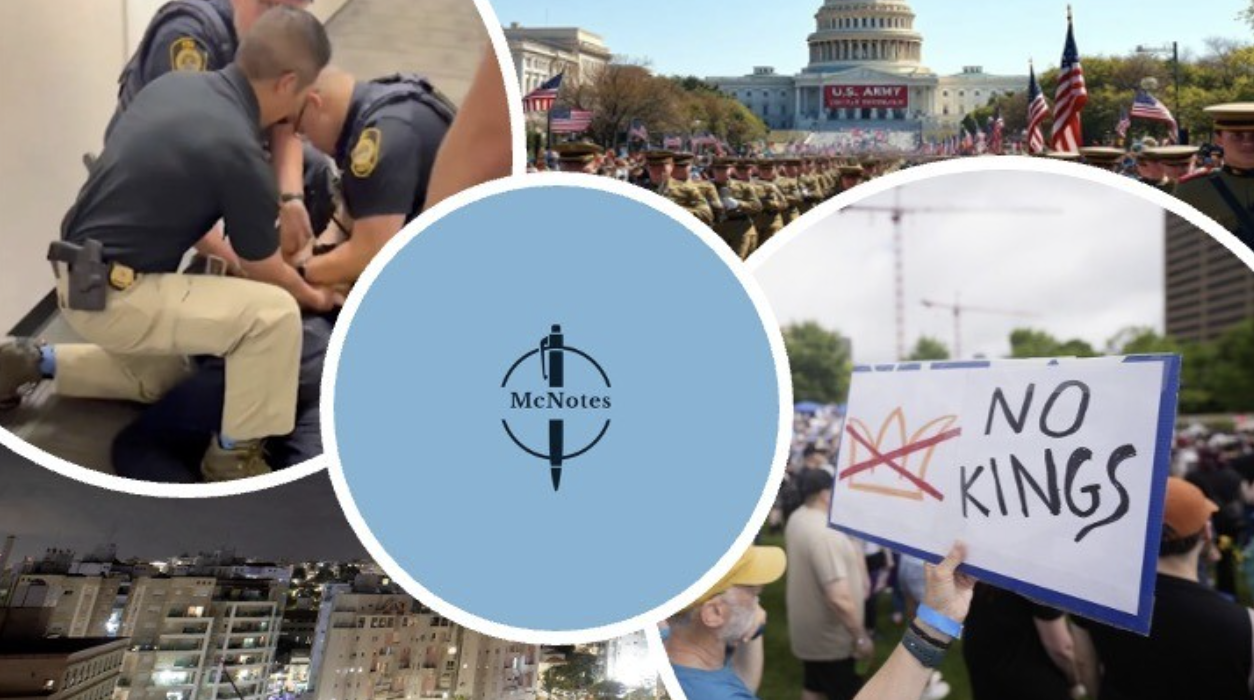
Years from now, June 14, 2025, may emerge in the rearview of history as one of those days when the deeper tensions of American life surfaced all at once. Not necessarily because of a single cataclysmic event, but because so many stories unfolded in parallel, each revealing a thread of the unraveling. These are the days we look back on not for their clarity but for their accumulation, not because they provided answers, but because they brought questions into sharper focus. If this date someday earns a chapter of its own, it will be for the way it revealed what kind of nation we were on the verge of becoming.
Across the country, crowds gathered under the banner of “No Kings,” a protest slogan that called to mind both our country’s founding rejection of monarchy and a more modern anxiety about the concentration of political power. Marchers filled streets and city squares, holding signs, singing songs, and carrying the weight of long-simmering frustration. In the nation's capital, though, the atmosphere told a different story. Washington, D.C. hosted a massive military parade to mark the 250th anniversary of the U.S. Army. The parade also served, not incidentally, as a birthday celebration for President Donald Trump. The spectacle featured thousands of troops, armored vehicles, and aircraft, complete with fireworks and official fanfare. It was a show of power and pageantry, and depending on your vantage point, either a symbol of national pride or an echo of something more imperial.
While flags waved and jets roared above Pennsylvania Avenue, a quieter, more intimate horror unfolded in Minnesota. Two state lawmakers were gunned down in what officials have called a politically motivated attack. Representative Melissa Hortman and her husband were killed at their home. Senator John Hoffman and his wife were seriously wounded in a similar assault at theirs. The attacker, dressed as a police officer, was apprehended carrying a list of more than seventy public officials. These were not random acts of violence. They were targeted, ideological, and premeditated. The line between rhetoric and bloodshed has been breached.
Meanwhile, in New York City, early voting began in the mayoral primary. Over five million registered voters are eligible to cast ballots in a race with high stakes for the city’s future. On any other day, this might be the headline. Today, it was one of many flickers of democratic routine trying to shine through the storm. That voters showed up at all, amid so much noise, is its own kind of resilience. The fact that voting could feel both urgent and peripheral is a sign of how unsteady the ground has become.
Far to the west, the tension between federal and local authority reached a boiling point. In Los Angeles, military units under the command of the federal government have been deployed to enforce immigration policy. The governor did not request their presence. Local officials have condemned the move. Yet the deployment continues, upheld for now by a federal court. We are only two days removed from a dramatic and deeply troubling scene in which California Senator, Alex Padilla, was handcuffed by local law enforcement while attempting to ask Secretary of Homeland Security, Kristi Noem, a question during her decidedly defiant press conference. Forty-seven Senate Democrats have issued a formal demand that the president withdraw the troops immediately. At the moment, there is no sign that he will.
And still, that is not all. Overnight, a series of coordinated Israeli strikes hit military and nuclear targets inside Iran, killing senior personnel and damaging sensitive facilities. Iran responded with a barrage of missiles and drones. Some were intercepted, others were not. The United States, drawn closer by alliance and obligation, has been pulled more deeply into the conflict. Talks scheduled for Sunday between U.S. and Iranian officials were abruptly canceled. The region inches closer to open war, with the potential to disrupt far more than geopolitics.
Taken together, these events form a mosaic of dissonance. It is not that the country is falling apart. It is that it seems to be coming apart in multiple directions at once. The familiar images of American life remain; elections, parades, speeches, but they are joined now by armored convoys, protest chants, political funerals, and courtroom battles. We still call ourselves a democracy, but increasingly, our rituals seem to run parallel to our realities, no longer in alignment. The substance and the symbols are drifting.
This is a moment of profound contradiction. The president watches a parade of tanks in his honor while senators are tackled by federal agents. Protesters gather in the name of freedom while elected officials are assassinated in their homes. Ballots are cast in school gyms while bombs fall in the Middle East. It is hard to hold all of this in one's mind at once. It is harder still to name what it means.
But perhaps this is the very heart of the matter. We are living in a time when coherence is no longer assumed, when each thread of American identity is being tugged by competing forces. What holds us together now is not shared agreement, but shared confrontation. We are confronting ourselves. We are confronting the limits of our institutions, the fragility of our civic trust, the implications of concentrated power, and the danger of dehumanized politics.
June 14, 2025 may yet become a date that historians look back on with particular attention. Not because it provided a singular moment of decision, but because it revealed the scale and shape of the crossroads we face. The question, as always, is what we will do with what has been revealed. Today, we do not know the answer.