Tis The Time's Plague
There’s an old story that keeps repeating.
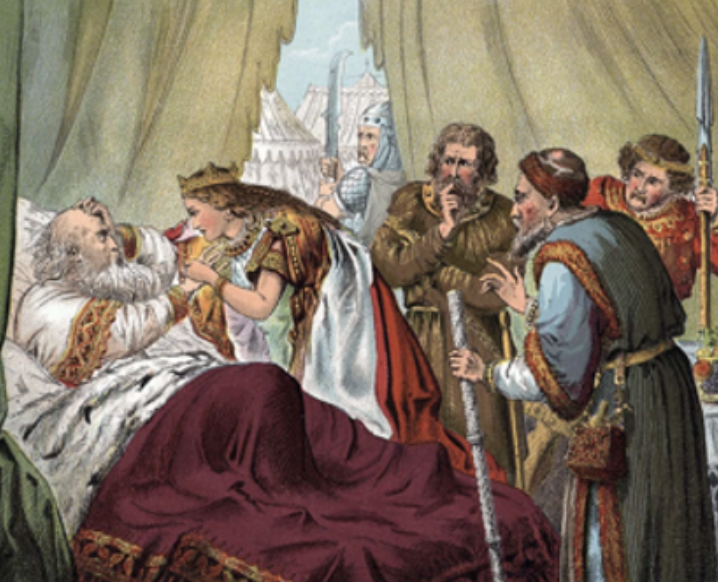
Sometimes it ends on a battlefield, sometimes in a bunker, sometimes on a stage, and sometimes in a storm. But always, at the center, there is a leader in decline, and a circle of people who saw the truth but failed to speak it.
This spring, Jake Tapper and Alex Thompson published Original Sin: President Biden’s Decline, Its Cover-Up, and His Disastrous Choice to Run Again. Though it reads like a political exposé, the book is more tragic than scandalous. It tells the story of a president who began to lose his ability to lead, and an inner circle that chose to protect the image rather than confront the reality. This is not a new story. It is a very old pattern and it can be observe in history, literature, and scripture.
By 1953, Joseph Stalin had ruled the Soviet Union for nearly three decades. He had constructed one of the most brutal authoritarian regimes in modern history, built on fear, surveillance, and repression. Those closest to him had survived purges, executions, and show trials. Their loyalty had been rewarded, but it had also been conditioned by terror. When Stalin suffered a massive stroke in March of that year, he collapsed on the floor of his private residence. His guards found him, but did nothing. His aides delayed calling a doctor for more than twelve hours. They debated. They hesitated. They were paralyzed by fear of acting without permission, fear of being accused of treason, fear of doing the wrong thing in the presence of the great leader.
Stalin was not yet dead, but the culture around him already was. It had become so dependent on his presence, so accustomed to silence and obedience, that no one could break the pattern, even when his life hung in the balance. When medical help was finally summoned, it was too late. Stalin died a few days later, not only of a hemorrhage, but of a system too terrified to tell the truth.
In Shakespeare's disturbing play, King Lear is an aging monarch who decides to divide his kingdom among his three daughters. Before doing so, he demands that each proclaim how much they love him. The two eldest, Goneril and Regan, flatter him with exaggerated praise. The youngest, Cordelia, refuses to exaggerate her love and instead speaks plainly and sincerely. Lear, enraged by her honesty, disowns her and banishes her from the kingdom.
This decision begins Lear’s descent into madness. As he splits power between the daughters who lied to him, they quickly strip him of his authority and dignity. He wanders into a storm, bitter, disoriented, and broken. Only too late does he realize the honesty he rejected and the betrayal he embraced. His court, like Stalin’s, had become a place where flattery was rewarded and truth was punished. No one dared tell Lear the truth about himself. No one stopped him from making a disastrous decision. And so the kingdom fell.
Saul was Israel’s first king, chosen by the prophet Samuel and anointed by God. At first, he was humble and reluctant to lead. But over time, power distorted him. He became impulsive, disobedient, and obsessed with maintaining his authority. One of the clearest signs of his decline was his jealousy toward David, a young warrior who gained popularity among the people. Saul grew erratic. He attempted to kill David. He made reckless decisions in battle. He consulted a medium in defiance of God’s law. He became isolated and suspicious, pushing away his advisors and the prophet who had once supported him.
Those around him followed orders, but few challenged him. The one person who could speak spiritual truth to him, Samuel, withdrew in sorrow. Saul’s army remained loyal, but their loyalty only delayed the inevitable. Saul’s final battle ended in disaster. Wounded and surrounded, he took his own life. His fall was not just the result of personal sin, but of a surrounding system that lacked the strength to intervene.
In each of these stories, Stalin, Lear, and Saul help us understand the modern example offered in Original Sin. Jake Tapper and Alex Thompson depict President Biden not as a tyrant, but as a leader in physical and cognitive decline whose inner circle chose to manage appearances rather than confront the truth. They report that aides controlled his schedule, minimized unscripted interactions, and edited events to hide signs of confusion or frailty. The justification was that Biden alone could defeat Donald Trump. But in attempting to protect him, they may have endangered the very cause they were fighting for.
There was no authoritarianism here, no madness, no moral evil. But there was a failure of courage. The same failure that let Stalin lie unattended, that let Lear banish the one honest voice, and that let Saul spiral into self-destruction.
So what are the leadership lessons we must take from these stories?
First, decline is inevitable. All leaders age. All institutions face moments of vulnerability. That is not the problem. The problem arises when the structures around a leader become so dependent on their authority, or so invested in their image, that they can no longer speak the truth.
Second, every system must protect space for honesty. Stalin built a system where honesty meant death. Lear built a court where praise was currency. Saul surrounded himself with yes-men. In each case, the truth was known, but it could not be said. That is the real danger, not the weakness of a leader, but the silence of those around them.
Third, loyalty to mission must outweigh loyalty to the person. When we build organizations, schools, churches, or governments that are centered on a single personality, we are always in danger of collapse. But when we build cultures where truth can rise, where power is shared, and where correction is welcomed, we give ourselves a fighting chance.
In King Lear, the moment of clarity comes too late. Lear recognizes his mistake, but only after Cordelia has been exiled and the kingdom torn apart. In the book of Samuel, Saul admits his failure. “I have played the fool", he realizes, but only after irreversible damage. In Stalin’s case, there is no repentance. The system he created long outlived him, still poisoned by the silence he demanded. And with Biden, according to Tapper’s account, the reckoning is only just beginning.
The question, then, is not whether leaders will decline. They will. The question is whether those around them have the integrity and courage to help them step down, to name what is real, and to protect the mission rather than the man. Every leader needs a Cordelia. Every president needs a Samuel. Every system needs someone who can say, with grace and conviction, “It’s time.” Not with cruelty. Not with arrogance. But with love for the truth, and loyalty to a cause greater than the individual. Because the madness at the center is never what brings the kingdom down.
It is the silence that surrounds it.
And yet, if we hoped we had learned our lesson, that hope may have been short-lived. One might imagine that after the painful revelations of Biden’s decline, the nation would take a breath, reflect, and recalibrate. That we would resolve not to build another system around a personality rather than a principle. That we would heed the ancient pattern and choose leaders who welcome truth rather than punish it.
But here we are again. The Trump presidency has returned, not with renewal, but with the same court of sycophants. Already, we see the same pattern: a leader incapable of accepting criticism, surrounded by loyalists unwilling to offer it. Truth is twisted to suit the whims of the man at the top, and those who dissent are cast out as traitors or losers. Institutions bend to fit the leader, rather than asking the leader to serve the institution.
This is not about politics. It is about power. It is about the danger of building any system where truth becomes subordinate to loyalty, and where the mission is held hostage to the personality of the one in charge. Whether left or right, progressive or populist, the lesson is the same. A kingdom falls not because the king is weak, but because no one dares to tell him so.
And we, the people, suffer the silence.